Pyramid's AI-driven Auto Translate automatically translates dynamic and static text into the application language configured for each user. Translations occur when a user views a presentation whose source language differs from their application language. Enable this feature to ensure text in your presentations is correct for users operating in different application languages.
Each user selects the application language that they want to use for Pyramid in their User Info panel.
- Click here for more information about User Info settings
Warning: When using LLMs, your assets are generated using public domain algorithms. This can produce erroneous and inconsistent or random results. Use at your own risk.
Automatically Translating Text
The Auto Translate function translates static and dynamic text strings added to the presentation. This includes:
- Static text.
- Dynamic text.
#SlideInsightstext fields.
Any other text is not translated. This includes cases where dynamic text is translated but the accompanying static text is not, even though static and dynamic text are typically both translated.
 Example: Auto Translate
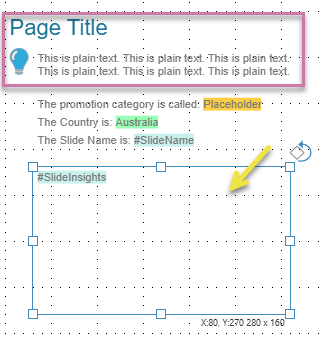
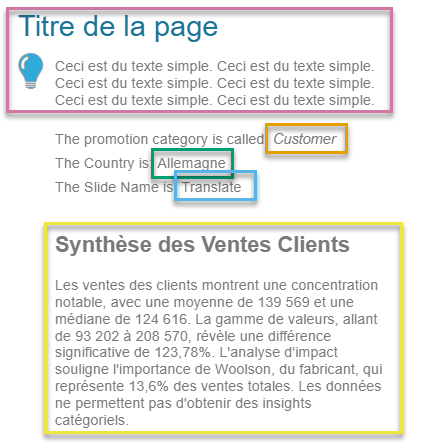
The following images show how Auto Translate affects different types of text on a slide. In this example, the presentation is authored in English and the user's application language is French:
|
|
- The title and block of static text (purple highlight above) are both translated into French.
- The dynamic placeholder (orange) and its accompanying static sentence are not translated.
- The dynamic text (green) is translated into French but its accompanying static sentence is not.
- The variable text field (blue) and its accompanying static sentence are not translated.
- The text field that contains only the
#SlideInsightsvariable is generated in French.
Prerequisites
You can only make use of this functionality if your administrator has selected to Enable Generative AI in the AI Settings page of the Admin Console. Otherwise, the function is not available for use.
Step 1: Enabling Auto Translate
From the Design ribbon:

- Click Auto Translate (green arrow above).
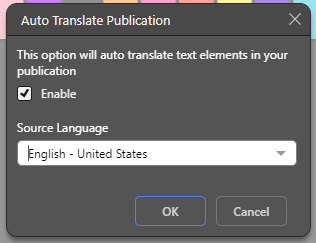
- Enable the Auto Translation:
- Select the Enable checkbox.
- Select a Source Language from the dropdown list. This is the language that the text is currently in, and selecting this option helps the underlying LLM to perform the translation into the user's application language.
- Click OK.
The Auto Translate dialog opens.
The dialog closes and Auto Translation is enabled.
The next time a user opens this presentation at runtime, Pyramid automatically translates any translatable text into that user's application language.
Step 2: Testing the translation
You can check that the correct replacements are made at runtime by changing your Application Language and then clicking the Run button or pressing F2 on your keyboard for a preview. Translations are generated on the fly and static and dynamic text is replaced accordingly.